







































































































































































6-12-25 Workout Method: Exercises, Muscle Growth, and Training Plan
Introduction
Author: RVLNSV PRASAD
Updated On: October 2026
About Us
Author Bio
Editorial Policy
Contact Us

Introduction
Building muscle does not always require complicated workout programs or hours in the gym. A well-planned resistance-training routine, appropriate weights, consistent effort, and enough recovery can make a meaningful difference over time.
The 6-12-25 workout method takes a different approach to organizing a training session. Instead of completing several traditional sets of one exercise, you perform three exercises for the same muscle group in succession. Each exercise uses a different repetition target: six, 12, and 25.
This structure can make a workout challenging and time-efficient. It also gives you a practical way to combine heavier compound movements with moderate-repetition exercises and lighter isolation work.
However, an intense workout is not automatically a better workout. Muscle growth depends on several factors, including training volume, effort, progressive overload, nutrition, and recovery. The American College of Sports Medicine’s 2026 resistance-training review supports progressive resistance training for improving muscle size and strength while showing that no single complicated training structure is necessary for everyone.
In this guide, you will learn how the 6-12- 25 workout method works, how to select suitable exercises, how to organize a training week, and how to progress without making every session exhausting.
Quick Answer: What Is the 6-12-25 Workout Method?
The 6-12-25 workout method is a resistance-training technique that combines three exercises targeting the same muscle group. You perform six repetitions of the first exercise, 12 repetitions of the second, and 25 repetitions of the third.
| Training stage | Repetitions | Typical exercise | Main purpose |
|---|---|---|---|
| First exercise | 6 | Bench press or squat | Practice heavier loading and develop strength. |
| Second exercise | 12 | Incline dumbbell press or leg press | Accumulate productive training volume. |
| Third exercise | 25 | Cable fly or leg extension | Train with lighter resistance and higher repetitions. |
You normally move between exercises with a short transition. After completing all three, rest before repeating the sequence.
This group of three exercises is often called a giant set or a three-exercise sequence. The method is associated with strength coach Charles Poliquin.
The repetition numbers describe a training format, not a scientifically proven formula for guaranteed muscle growth. Your results will depend on how the method fits into your overall training program.
How Does the 6-12-25 Workout Method Work?
The method changes the exercise, repetition target, and usually the resistance as you move through the sequence.
1. Six repetitions: Begin with a heavier exercise.
The first movement generally uses a compound exercise that involves several joints and muscle groups.
Examples include the bench press, squat, pull-up, and supported row.
Choose a load that allows six controlled repetitions without compromising your technique. Six repetitions should not mean lifting the heaviest weight possible regardless of form.
Heavier resistance is particularly useful for strength development. The 2026 ACSM evidence review found that lifting heavier loads was an important factor for maximizing strength gains.
2. Twelve repetitions: Continue with a moderate load.
The second exercise usually targets the same muscle group through a different movement or angle.
For a chest workout, you might follow the bench press with an incline dumbbell press. For a leg session, a squat could be followed by a leg press.
Use a weight that lets you complete 12 repetitions with a controlled range of motion. You should feel challenged, but you should not need to swing the weights or shorten the movement to finish.
3. Twenty-five repetitions: Finish with a lighter movement.
The final exercise typically uses a lighter load and emphasizes muscular endurance.
Examples include cable flyes, leg extensions, lateral raises, or cable curls.
Twenty-five repetitions can become difficult, particularly after the first two exercises. Reduce the load enough to maintain control throughout the set.
You do not need to force the final repetitions if your technique deteriorates. The goal is productive training, not completing an arbitrary number at any cost.
What Does the Latest Research Say About the 6-12-25 Method?
There is an important difference between evidence supporting resistance training and evidence supporting one specific workout protocol.
The general benefits of resistance training are well established. However, the exact 6-12-25 combination has not been established as superior to conventional training through strong direct comparative evidence.
The 2026 ACSM review: Why the basics still matter
A major 2026 review published in Medicine & Science in Sports & Exercise synthesized 137 systematic reviews involving more than 30,000 participants.
The researchers found that resistance training improved muscle strength, muscle size, power, endurance, and several measures of physical function.
The review also highlighted several useful findings:
- Higher weekly training volumes can support muscle hypertrophy.
- Heavier loads are particularly useful when strength is the main goal.
- Progressive resistance training should be adapted to the individual’s needs and abilities.
- Training to complete muscular failure and using complicated set structures did not consistently improve outcomes.
These findings are relevant to the 6-12-25 workout method because they help explain which parts of a training plan matter most.
The evidence does not show that combining exactly six, 12, and 25 repetitions automatically produces more muscle growth than other effective routines.
Does training to failure build more muscle?
A demanding final set may feel productive, but reaching complete muscular failure on every set is not essential.
A systematic review with meta-analysis on proximity to muscular failure found no clear hypertrophy advantage for momentary muscular failure over non-failure training in the comparisons examined.
For the 6-12-25 method, this means you can finish a set when you have reached the intended effort level and can no longer maintain good technique. You do not need to turn every sequence into an all-out test.
Does the muscle burn cause growth?
The burning sensation during high-repetition exercise is common. It can occur as exercise intensity and local fatigue increase.
However, the burn itself is not proof that an exercise will produce more muscle growth. Nor does the amount of soreness after training reliably measure how effective a session was.
A more useful approach is to track your training performance, total workload, technique, recovery, and gradual improvements over time.
Main Benefits of the 6-12-25 Hypertrophy Workout
The method has several practical advantages when used appropriately.
It provides variety within one training sequence.
The three exercises allow you to challenge a muscle group through different movements and resistance levels.
For example, a chest sequence can begin with a bench press, continue with an incline press, and finish with a cable fly. This can make a session more varied without requiring an unnecessarily large exercise list.
It can make workouts feel time-efficient.
Because the exercises are performed in succession, you may spend less time sitting between individual exercises than you would in a traditional routine.
However, the method is not guaranteed to be faster. Setting up equipment, moving between stations, and resting adequately can take time.
It combines strength-oriented and endurance-oriented work.
The lower-repetition exercise allows you to practice heavier loading, while the higher-repetition movement develops your ability to sustain repeated contractions.
This does not mean that each repetition range trains a completely separate type of muscle growth. Muscle adaptations overlap, and several repetition ranges can support hypertrophy when the training is sufficiently challenging.
It encourages structured progression.
The fixed repetition targets make it relatively straightforward to track progress. You can record the weight used for six repetitions, the load used for 12, and the load used for 25.
Over time, you can increase resistance when you consistently complete the prescribed repetitions with controlled technique.
Best Exercises for the 6-12-25 Workout Method
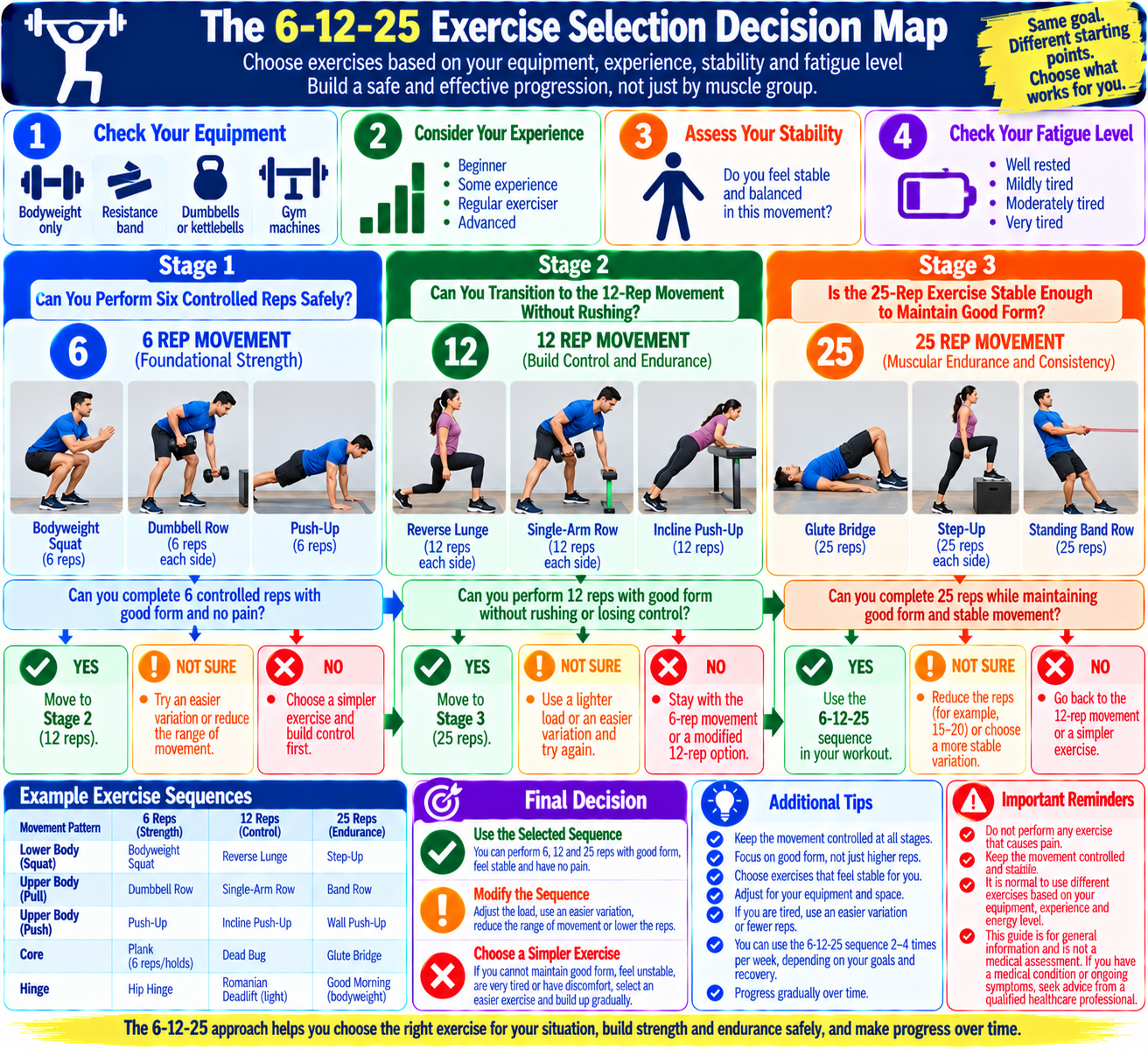
The exercises should target the same primary muscle group while allowing you to maintain safe technique as fatigue accumulates.
| Muscle group | 6 repetitions | 12 repetitions | 25 repetitions |
|---|---|---|---|
| Chest | Bench press | Incline dumbbell press | Cable fly |
| Back | Supported heavy row | Lat pulldown | Straight-arm cable pulldown |
| Quadriceps | Squat | Leg press | Leg extension |
| Shoulders | Seated shoulder press | Dumbbell lateral raise | Cable lateral raise with light resistance |
| Biceps | Heavy dumbbell curl | Incline dumbbell curl | Cable curl with light resistance |
| Triceps | Close-grip bench press | Cable triceps extension | Light rope pressdown |
| Glutes | Hip thrust | Dumbbell Romanian deadlift | Cable glute kickback |
These are example exercise pairings, not mandatory combinations. Exercise selection should reflect your equipment, experience, mobility, and training goals.
For beginners, machines and supported exercises can make it easier to maintain a stable position. Advanced lifters may have more options, but experience does not remove the need for appropriate load selection.
6-12-25 Chest Workout: A Practical Example
The chest is a useful example because it can be trained with a combination of pressing and isolation exercises.
Chest workout table
| Exercise | Repetitions | Sets | Rest |
|---|---|---|---|
| Bench press | 6 | 2 initially | Brief transition |
| Incline dumbbell press | 12 | Part of the same sequence | Brief transition |
| Cable fly | 25 | Part of the same sequence | 2–3 minutes after the sequence |
How to perform it: Complete six bench-press repetitions, move to the incline dumbbell press for 12 repetitions, and finish with 25 controlled cable flyes. Rest for two to three minutes before starting another sequence.
The two initial sets are a conservative starting point for someone familiar with resistance training. If you are new to this format, begin with one sequence while learning the movements. Do not add more sets simply because the first session feels manageable.
The bench press requires particular attention because fatigue can affect control of the bar. Use appropriate safety supports or a competent spotter, and do not take a heavy press to failure when you cannot safely release the weight.
If you train without a spotter, consider a chest press machine or another suitable alternative.
6-12-25 Leg Workout: A Practical Example
Leg training can produce considerable fatigue because exercises such as squats and leg presses involve large muscle groups.
That is why the exercise order and weight selection matter.
| Exercise | Repetitions | Purpose |
|---|---|---|
| Squat or suitable squat variation | 6 | Practice controlled, heavier lower-body work. |
| Leg press | 12 | Accumulate additional quadriceps training volume. |
| Leg extension | 25 | Finish with lighter, higher-repetition work. |
Begin with a manageable squat variation that suits your mobility and experience. If you cannot maintain balance or a stable position, use a supported variation or machine instead.
Do not rush from the squat rack to another station if doing so would compromise safety. The transition should be organized before the session begins.
After completing all three movements, rest for two to three minutes or longer if necessary to regain control of your breathing and prepare for another quality set.
You can apply the same principles to a back or arm session, but you do not need to perform every possible variation in one workout.
How Many Sets Should You Perform?
More sets are not automatically better. The correct amount depends on your experience, current training volume, recovery, and how many other exercises you perform during the week.
| Experience level | Starting approach | Progression |
|---|---|---|
| Beginner | Learn the three movements separately before using the full sequence. | Add the method only when the basic technique is consistent. |
| Intermediate | Start with 1–2 sequences for a selected muscle group. | Add a set only if recovery and performance remain satisfactory |
| Advanced | Use the method selectively within a planned program. | Adjust total weekly volume to account for the extra fatigue. |
A 6-12-25 sequence is not equivalent to one ordinary set in terms of fatigue. It includes three separate exercises and multiple challenging sets of repetitions.
The 2026 ACSM review identifies higher weekly training volume as one factor that can support hypertrophy. However, your total volume must remain manageable.
Count the exercises you perform elsewhere in your program rather than treating this method as additional work that has no effect on recovery.
How Much Rest Do You Need?
The 6-12-25 workout is often described as a short-rest training method, but that does not mean you should eliminate rest regardless of the exercise.
A practical starting point is to use only the time needed to move safely between exercises, followed by approximately two to three minutes after completing the sequence.
You may need longer if your breathing remains elevated or your performance would otherwise suffer.
The objective is not to maintain the highest possible heart rate. It is to perform the prescribed movements with adequate effort and control.
If you cannot recover enough to maintain technique during the second or third exercise, reduce the load, lengthen the rest period, or simplify the sequence.
A Simple Weekly Training Plan
You do not need to use the 6-12-25 method for every muscle group in every session. In fact, applying it selectively may make it easier to control fatigue.
Here is an example of how an intermediate trainee might organize a week. Adjust it according to your current experience and recovery.
| Day | Training focus | Approach |
|---|---|---|
| Monday | Chest and triceps | One selected 6-12-25 sequence, followed by appropriate additional work |
| Tuesday | Lower body | Conventional resistance training or a modified leg sequence |
| Wednesday | Recovery | Walking, comfortable mobility work, or rest |
| Thursday | Back and biceps | One selected 6-12-25 sequence |
| Friday | Shoulders and other planned work | Moderate training volume, avoiding unnecessary overlap |
| Saturday | Optional light activity | Walking, cycling, or other comfortable activity |
| Sunday | Rest | Recover and prepare for the next week. |
This is an example, not a universal prescription. Someone who is new to resistance training may benefit from a simpler full-body routine performed on nonconsecutive days.
If you train each muscle group only once per week, make sure your overall program still provides an appropriate amount of weekly work. The best schedule is one you can maintain while progressing and recovering.
How to Progress With the 6-12-25 Workout Method
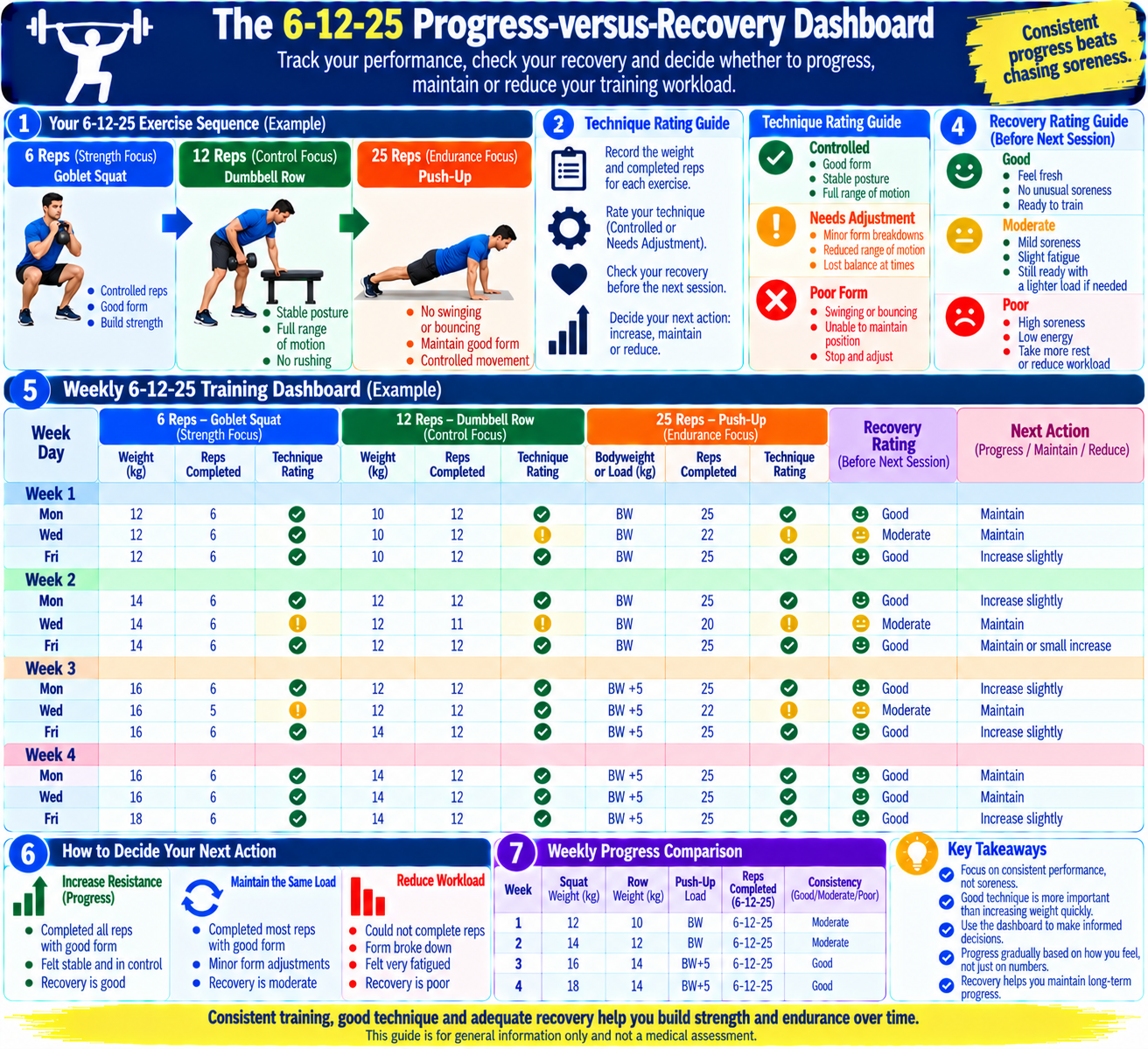
Progressive overload means gradually increasing the challenge placed on your muscles. You do not need to increase weight, repetitions, and intensity simultaneously.
Use a simple progression system.
Step 1: Record your starting performance. Write down the exercise, load, repetitions, and any technique problems.
Step 2: Build consistency. Repeat the same sequence until you can complete the prescribed repetitions with stable form.
Step 3: Increase resistance gradually. When you can consistently complete all repetitions with good technique, make a small increase in weight if the equipment allows it.
Step 4: Monitor the next session. If the increased load causes you to lose control or miss the target repetitions, reduce it and progress more gradually.
Step 5: Adjust volume only when necessary. Add another sequence only if you are recovering well and have a reason to increase your training volume.
A simple log helps you separate genuine progress from temporary muscle pumps or soreness.
| Training measure | What to record |
|---|---|
| Load | Weight used for each exercise |
| Performance | Repetitions completed with good technique |
| Effort | How challenging the set felt |
| Recovery | Whether you felt ready for the next session |
| Progress | Changes in load, repetitions, or movement control |
The most useful sign of progress is not how exhausted you feel. It is whether your performance and training consistency improve over time.
Nutrition and Recovery for Muscle Growth
The 6-12-25 workout method cannot compensate for inadequate nutrition or poor recovery. Your muscles need sufficient energy, protein, and rest to adapt to resistance training.
Eat enough protein.
Protein provides amino acids used in muscle repair and growth. Include suitable sources such as eggs, dairy products, fish, lean meat, soy foods, beans, lentils, and other pulses.
A major systematic review and meta-analysis on protein supplementation and resistance training found that protein supplementation can support gains in muscle mass and strength during resistance training, although supplementation is not necessary for everyone who already consumes sufficient protein.
The amount you need depends on your body size, diet, activity, and health circumstances. A varied diet can provide much of your daily requirements.
Eat enough to support training.
Carbohydrate-containing foods can help provide energy for demanding sessions. Rice, oats, potatoes, fruit, whole grains, and other carbohydrate sources can fit into a balanced eating pattern.
Dietary fats also play an important role in general health. Avoid eliminating an entire macronutrient group because you believe it will accelerate muscle growth.
Make sleep a priority.
Consistent sleep supports recovery and daily performance. If you repeatedly feel exhausted, your performance declines, or soreness interferes with normal movement, review your sleep and training schedule before increasing workout intensity.
Do not rely on soreness as your progress measure.
A productive session does not have to leave you unable to move comfortably the next day. Excessive soreness can make subsequent workouts harder and reduce your ability to train consistently.
Use performance, recovery, and gradual progression to judge whether the method is working for you.
A Practical Improvement: The Fatigue Check Before Every Sequence
One useful way to apply this method is to make a short readiness check part of your routine. It is a practical self-monitoring strategy, not a clinically validated test.
Before beginning another 6-12-25 sequence, ask yourself three questions:
- Can I control the first exercise? If you cannot set up safely or maintain your normal technique, reduce the load or stop.
- Can I move to the next exercise without rushing? If equipment changes create a safety problem, reorganize the sequence.
- Can I complete the final exercise without swinging or shortening the movement excessively? If not, reduce the weight or stop the set.
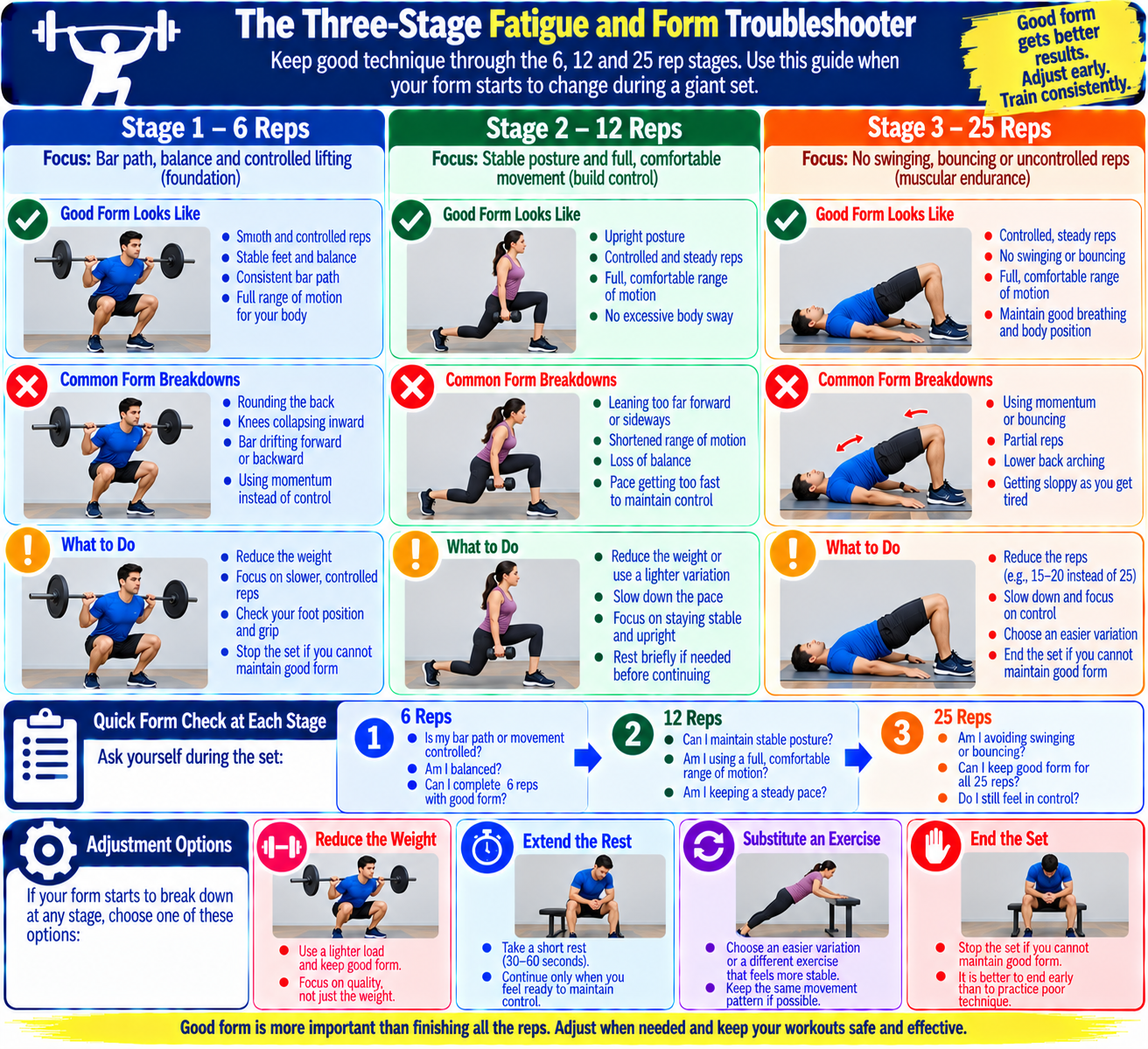
This approach helps address a common weakness of giant sets: fatigue can build quickly, making it tempting to prioritize finishing the numbers instead of performing each repetition properly.
You can also record your answer after each session. If technique repeatedly deteriorates during the third exercise, use a lighter load, choose a simpler movement, or increase the rest period.
The purpose is to make the method repeatable rather than turning every workout into a test of willpower.
Common Mistakes to Avoid
Using too much weight
The six-repetition exercise should be challenging, but it should not compromise your technique. A load that you can lift only by twisting, bouncing, or shortening the movement is too heavy for the intended task.
Treating every set as a maximum-effort test
Repeatedly forcing yourself to failure can create unnecessary fatigue. Evidence does not establish that every set must reach momentary muscular failure to stimulate hypertrophy. Review the systematic evidence on proximity to failure when planning how hard to train.
Resting too little
Short transitions are part of the method, but they should not force you to begin the next movement before you can perform it safely. Rest longer when needed.
Performing too many sequences
The combination of three exercises can be demanding. Adding numerous sequences to an already high-volume program may reduce recovery without providing a clear benefit.
Ignoring exercise overlap
Your chest, shoulders, and triceps may all work during pressing exercises. If you train each muscle group hard on consecutive days, accumulated fatigue can become a problem.
Plan your weekly routine around the total work performed by each muscle group.
Confusing muscle burn with muscle growth
A strong pump can feel satisfying, but it does not prove that the workout is more effective. The burn is a sensation, not a reliable measure of long-term hypertrophy.
Changing too many variables at once
If you increase weight, add sets, shorten rest, and introduce new exercises simultaneously, it becomes difficult to identify what helped or hurt your progress.
Change one variable at a time whenever possible.
Who Should Use the 6-12-25 Workout Method?
The method is most suitable for people who already understand basic resistance-training techniques and can control their movements when fatigued.
Intermediate trainees may find it useful as an occasional training variation, particularly when they want a structured sequence for one muscle group.
Advanced lifters can consider using it selectively within a broader program, provided they monitor total training volume and recovery.
Beginners should first learn fundamental movement patterns, how to choose manageable weights, and how to progress safely. They do not need an advanced giant-set method to build muscle.
People with current injuries, persistent joint pain, or medical conditions that affect exercise should seek appropriate guidance before trying a demanding routine. A qualified fitness professional can help select movements and adjust training loads to individual needs.
Is the 6-12-25 Workout Method Good for Fat Loss?
The method involves resistance exercise and can contribute to total daily energy expenditure. However, it should not be presented as a guaranteed fat-loss shortcut.
Body-fat reduction depends on overall energy balance, dietary habits, physical activity, sleep, and other individual factors.
Resistance training can help preserve or develop muscle during a weight-management program. If fat loss is your main goal, combine suitable resistance training with sustainable eating habits and regular physical activity rather than relying on the intensity of one workout format.
Do not assume that a higher heart rate or stronger muscle burn means that you have lost more body fat.
Frequently Asked Questions
1. What is the correct order for a 6-12-25 workout?
The typical order is six repetitions of a heavier compound exercise, 12 repetitions of a moderate-load exercise, and 25 repetitions of a lighter exercise targeting the same muscle group.
2. Can beginners try the 6-12-25 workout method?
Beginners should first develop consistent technique and learn how to select suitable weights. A simpler resistance-training program is usually a more manageable starting point.
3. How many sets should I perform?
Start conservatively. One or two sequences for a selected muscle group may be sufficient to learn the method, depending on your training background and existing workload. Increase only when you can recover and maintain good technique.
4. How long should I rest after a sequence?
Approximately two to three minutes is a practical starting point. Take longer if needed to recover enough to perform the next sequence safely.
5. Does the 6-12-25 workout method build muscle faster than traditional training?
There is insufficient strong direct evidence to claim that this exact method consistently builds muscle faster than other effective resistance-training programs. Its value depends on how well it fits your goals, training volume, effort, and recovery.
6. Can I do a 6-12-25 chest workout at home?
Yes, if you have suitable equipment and can perform the movements safely. Dumbbells, resistance bands, or other appropriate equipment can provide alternatives, although you may need to modify the exercise sequence.
7. Should I feel sore after every workout?
No. Soreness is not required for muscle growth. Persistent soreness that affects movement or subsequent sessions is a reason to review your workload and recovery.
8. Can I use the method for every muscle group?
You can adapt the format to several muscle groups, but using it everywhere may create excessive fatigue. Start with one selected muscle group and assess how you recover before expanding its use.
9. Is the 6-12-25 method suitable for strength training?
The six-repetition exercise can support strength development, particularly when the load is appropriately challenging. However, a program focused on maximal strength may require more specific heavy-lifting practice and longer recovery periods.
10. How long does it take to see muscle growth?
The timeline varies according to training experience, nutrition, genetics, consistency, and recovery. Avoid promising visible transformation within a fixed number of weeks. Track performance and body measurements over time instead.
Key Takeaways
- The 6-12-25 workout method combines six, 12, and 25 repetitions across three exercises for the same muscle group.
- It can provide a structured and demanding training session, but it is not proven superior to other effective workout methods.
- Choose weights that allow controlled repetitions rather than sacrificing technique to complete the target.
- Rest sufficiently between sequences and monitor your total weekly training volume.
- Progressive overload, adequate protein, sufficient energy, and consistent recovery remain important for muscle growth.
- Beginners should learn the fundamentals before attempting demanding giant sets.
- Judge progress by training performance and consistency, not solely by muscle burn or soreness.
Conclusion
The 6-12-25 workout method offers a practical way to combine heavier resistance, moderate-repetition work, and lighter high-repetition exercises in one training sequence. It can add variety to a muscle-building program and help experienced trainees organize their sessions.
However, the method is not a shortcut around the fundamentals of resistance training. You still need suitable exercise selection, manageable weekly volume, progressive overload, good technique, and adequate recovery.
Start with a small amount of work, record your performance, and make adjustments according to how your body responds. If the method helps you train consistently and progress without compromising technique, it may be a useful addition to your routine.
The best workout is not necessarily the most brutal one. It is the one that helps you improve while allowing you to recover and return ready to train again.
Author Note
Author: RVLNSV PRASAD
This article explains the 6-12-25 workout method using current resistance-training evidence and practical exercise guidance. It is intended to help readers understand the method, its potential uses, and its limitations. Personal training experiences should be included only when they reflect genuine, firsthand experience.
Medical Disclaimer
This article is for general educational purposes only and is not a substitute for individualized medical advice, diagnosis, or treatment. Consult a qualified healthcare professional before beginning a new exercise program if you have a medical condition, an injury, or concerns about your ability to exercise safely.
Fitness Disclaimer
Exercise technique, resistance, and training volume should be adapted to your experience and abilities. Stop exercising if you experience sharp pain, chest pain, faintness, or unusual shortness of breath, and seek appropriate medical attention when necessary. Do not sacrifice safe technique to complete a prescribed repetition target.
Sources
- American College of Sports Medicine (2026): Resistance Training Prescription for Muscle Function, Hypertrophy, and Physical Performance in Healthy Adults: An Overview of Reviews. A major synthesis of resistance-training evidence.
- American College of Sports Medicine (2026): Updated resistance-training guidelines. An accessible summary of the updated recommendations.
- Resistance training and muscular failure: Systematic review and meta-analysis on proximity to failure and muscle hypertrophy.
- Protein and muscle development: Systematic review and meta-analysis of protein supplementation during resistance training.
- HealthShots: 6-12-25 workout: Benefits and how to do it. General explanation and exercise examples.
- Tom’s Guide: What is the 6-12-25 method and is it good for building muscle?. Additional context on how the method is commonly applied.
related posts
- Active Living
- 10 Ways to Reverse Type 2 Diabetes Permanently
- Chest Workouts Without Equipment: Best 12 Moves to Build Muscle at Home
- Train Smarter, Not Harder: Optimizing Workouts for Maximum Results
- 13 Best Ways To Boost Metabolism With Exercise
- Full Abs Workout at Home: Daily Routine to See Results in 30 Days












[…] 6 12 25 Workouts: The Muscle-Building Secret Behind This Brutal Hypertrophy Method […]
[…] 6 12 25 Workouts: The Muscle-Building Secret Behind This Brutal Hypertrophy Method […]
[…] 6 12 25 Workouts: The Muscle-Building Secret Behind This Brutal Hypertrophy Method […]